Build the Frog
Build the Frog
EARLY MIOCENE · ABOUT 20 MILLION YEARS AGO
You are a frog.
You have eyes, ears, legs, and a tongue.
Unfortunately, none of them are connected.
Build a tiny nervous system by placing neurons and wiring them between the frog’s senses and muscles. Then release your creation into a series of challenges to see whether its brain produces the behavior you intended.
Example solutions are provided!
Can you build a frog that leaps, hunts, escapes danger, and finds a mate?
Approximate demo length: 5–10 minutes
Playtesters
This is an educational game about how simple neural circuits can produce surprisingly complex behavior.
The game attempts to introduce ideas from neuroscience through experimentation rather than equations or technical explanations.
My main question:
Is building and testing tiny nervous systems interesting enough to make into a full game?
The demo contains six challenges:
Level 1: First Leap
Make your frog leap whenever it sees something.
Level 2: Face the Fly
Make your frog turn towards a fly.
Level 3: Catch a Fly
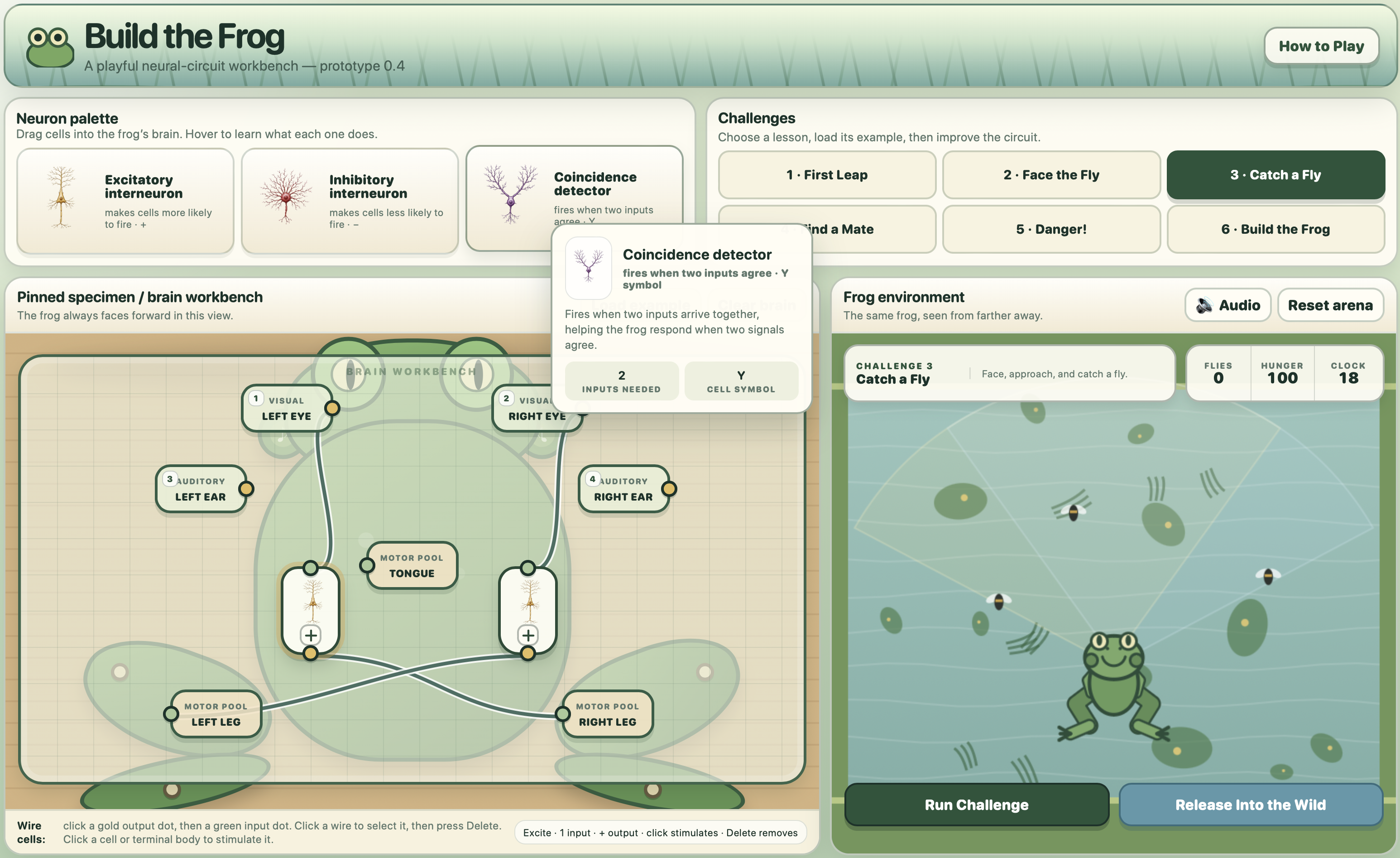
Make your frog lick when there is a fly in front of it.
Level 4: Find a Mate
Make your frog follow a mating call.
Level 5: Danger!
Make your frog panic leap when in immediate danger.
Level 6: Build the Frog
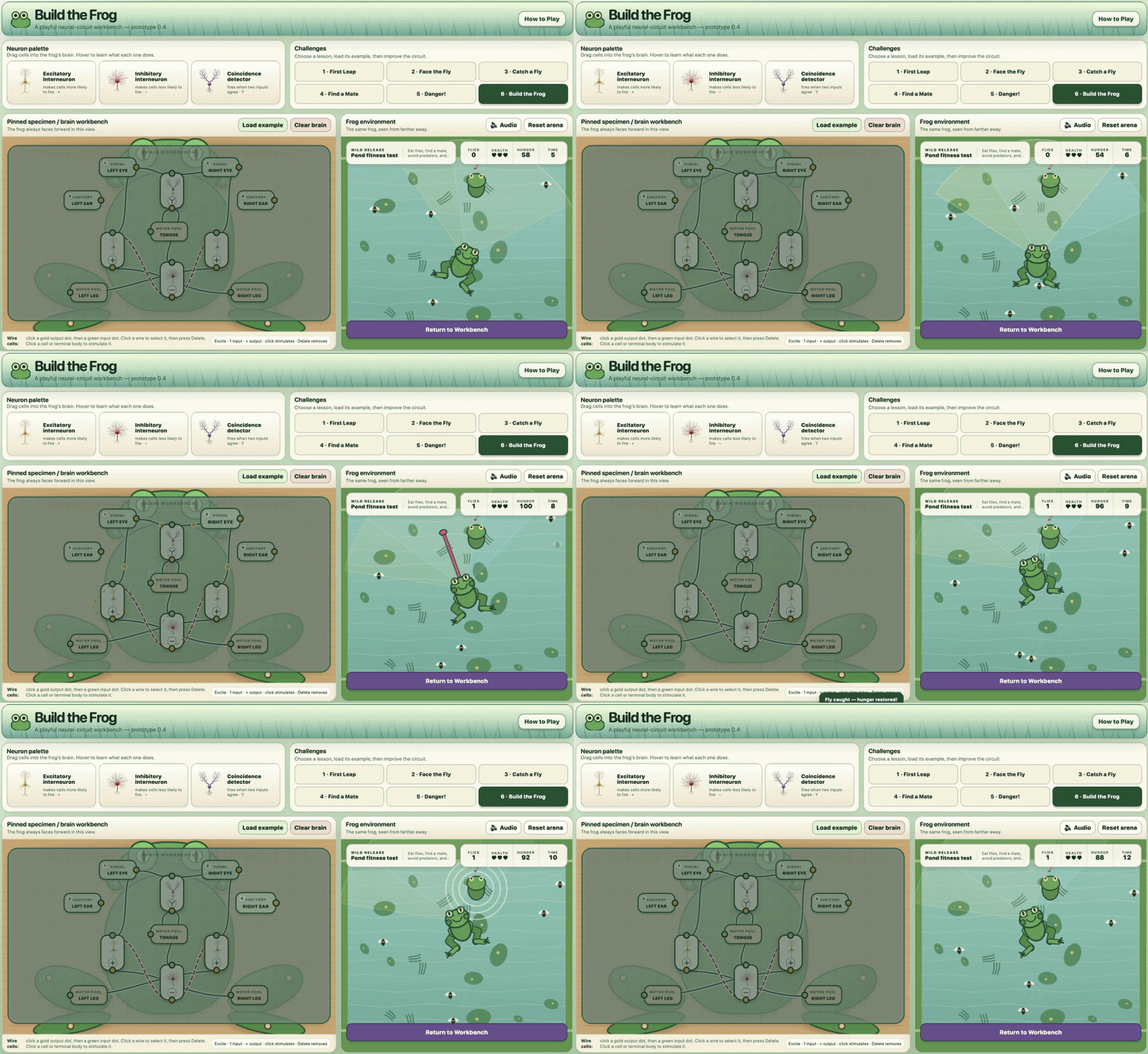
Combine everything you have learned and release your frog in the full pond environment. Does it survive the Miocene wetlands?
After playing, I would especially appreciate your thoughts on these questions:
- Did you understand how to place and connect neurons?
- Did the differences between excitatory, inhibitory, and coincidence neurons make sense?
- Did you understand why your frog behaved the way it did?
- Did experimenting with different circuits feel interesting or rewarding?
- Did the challenges teach the mechanics clearly without too much explanation?
- Would you want to build more complicated brains or solve additional challenges?
- Was anything confusing, frustrating, or unexpectedly fun?
Thank you so much for testing the game. Even a very short comment is extremely valuable.
How to Play
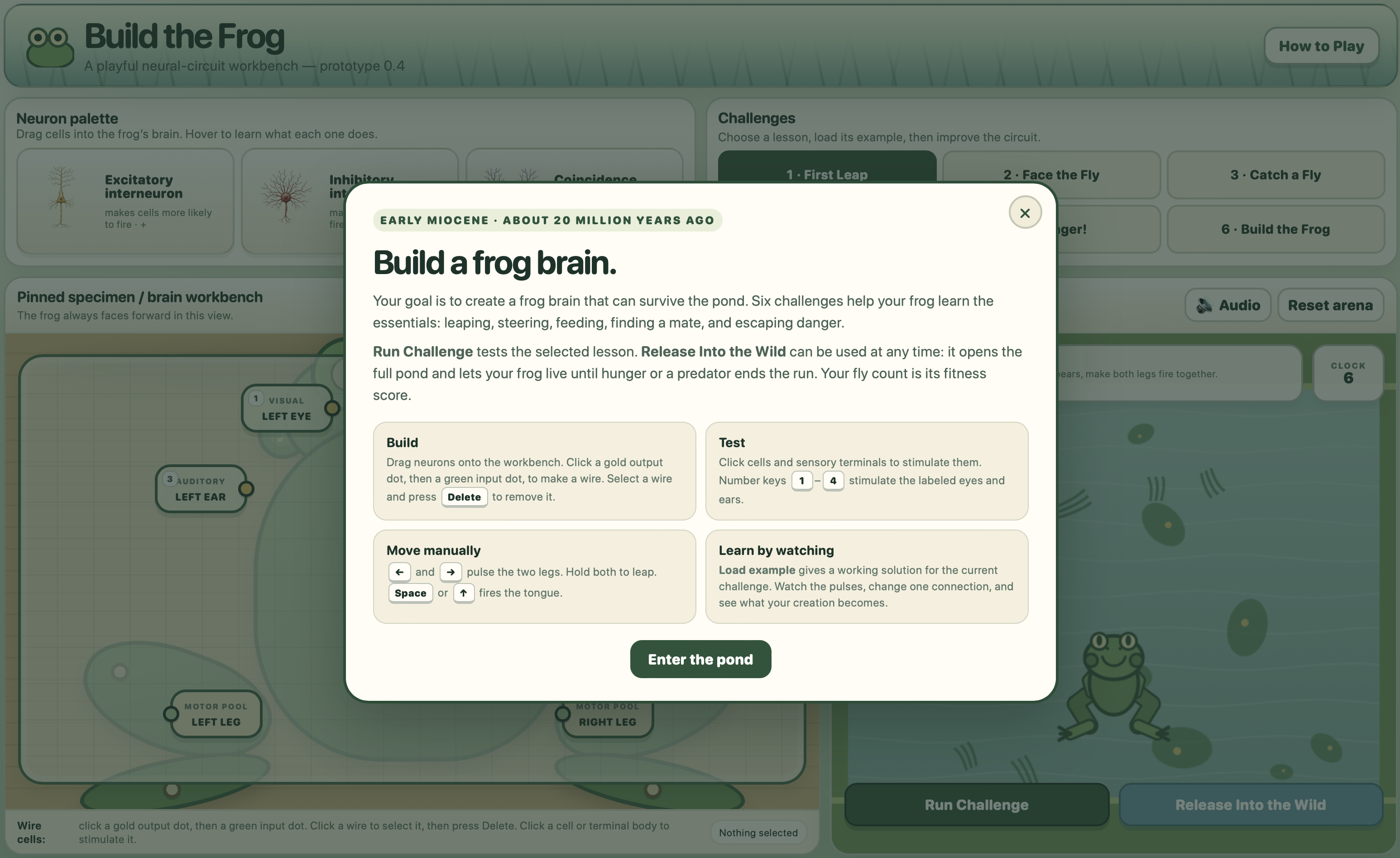
Drag neurons from the palette into the frog’s brain.
Connect the frog’s sensory systems to neurons, then connect those neurons to its movements.
Excitatory neurons help signals continue through a circuit.
Inhibitory neurons reduce or suppress activity.
Coincidence neurons respond when multiple signals arrive together.
Press Run Challenge to test the brain you built.
Observe what the frog does, adjust the circuit, and try again.
You are free to solve each challenge in any way that works.
To remove a connection, select the wire and press Delete or Backspace.
Browser Notes
Desktop only. Mobile is not currently supported.
Best experience: Safari
Also tested in: Chrome
Wired headphones or speakers recommended. Bluetooth audio may occasionally glitch.
Current Status
Version 0.4
This is a six-level educational mechanics demo made to test the central ideas for a possible larger game.
It includes a complete introductory progression and a final open-ended challenge, but it is not yet a full game.
The neurons and behaviors are intentionally simplified, but the central idea I want to communicate (while having fun):
Complex behavior can emerge from surprisingly small circuits.
Leave a comment
Log in with itch.io to leave a comment.